Best Value
from$99/mo
SemaglutideRx
GLP-1 Receptor Agonist

SemaglutideRx
GLP-1 Receptor Agonist
TirzepatideRx
Dual GLP-1 + GIP Receptor Agonist
Semaglutide ODT PillsRx
GLP-1 Receptor Agonist - Oral Dissolving Tablet
Tirzepatide ODT PillsRx
Dual GLP-1 + GIP Receptor Agonist - Oral Dissolving Tablet
Men's Complete Hair Growth PillRx
Minoxidil, Finasteride, Biotin
Men's Advanced Hair SprayRx
Minoxidil, Finasteride, Fluocinolone, Tretinoin
Women's Premium Hair SprayRx
Minoxidil, Tretinoin, Fluocinolone, Biotin, Melatonin
Women's Complete Hair Growth PillRx
Minoxidil, Vitamin E, Biotin
Written by Join Luma Team
November 16, 2026 · 7 min read
Many people on a GLP-1 do well aiming for about 80 to 120 grams of protein a day, a simple target suggested in a 2025 joint nutrition advisory. The basic minimum for adults is 0.8 grams per kilogram of body weight, and higher goals of 1.2 to 1.6 g/kg have been proposed during active weight loss.
Eat protein first at each meal, spread it across the day, and pair it with strength training. Your doctor or a dietitian can help set the right number for you, especially if you have kidney disease.
GLP-1 medications like semaglutide and tirzepatide lower your appetite, so you eat less. That helps you lose weight, but when you lose weight quickly, some of what you lose is muscle, not just fat.
In the STEP 1 semaglutide trial, about 62% of the weight people lost was fat and about 38% was lean body mass, which includes muscle and other non-fat tissue. Keeping your muscle helps you stay strong, keeps your metabolism working and supports your bones. Eating enough protein, along with strength training, is the best way to protect it.
The challenge: with a smaller appetite, it's easy to fall short on protein without noticing. Learn more in our guide to muscle loss on GLP-1s.
There is no single official number for people on GLP-1 medications yet. Here is what the 2025 joint advisory from four U.S. nutrition and obesity medicine groups says:
“setting an absolute protein target of 80–120 g/d, or 16%–24% energy on a 2000 kcal/d diet, may enhance adherence while ensuring adequate intake”
Why a simple number? The advisory explains that for people with obesity, multiplying grams by your full body weight can overestimate how much protein you really need. A fixed range of 80 to 120 grams is easier to follow and still covers most people.
To find the basic minimum, multiply your weight in pounds by 0.36. That's the same as 0.8 grams per kilogram. Then compare it with the 80 to 120 gram range.
| Body weight | Basic minimum (0.8 g/kg) | Simple GLP-1 target |
|---|---|---|
| 150 lb (68 kg) | About 54 g a day | 80 to 120 g a day |
| 200 lb (91 kg) | About 73 g a day | 80 to 120 g a day |
| 250 lb (113 kg) | About 91 g a day | 80 to 120 g a day |
More isn't always better. The advisory says protein should not fall below 0.4 to 0.5 g/kg a day, and eating 2 g/kg or more for a long time should be avoided. If you have kidney disease or another health condition, ask your doctor before raising your protein.
Spreading protein across the day is easier than trying to eat it all at once, especially when you feel full quickly. If you eat 3 to 4 small meals, 80 to 120 grams works out to roughly 20 to 40 grams per meal.
A simple habit helps a lot: eat your protein first. The advisory suggests protein-rich foods "can be consumed first in a meal to increase the likelihood of sufficient consumption." That way, if you only finish half your plate, you still got the most important part.
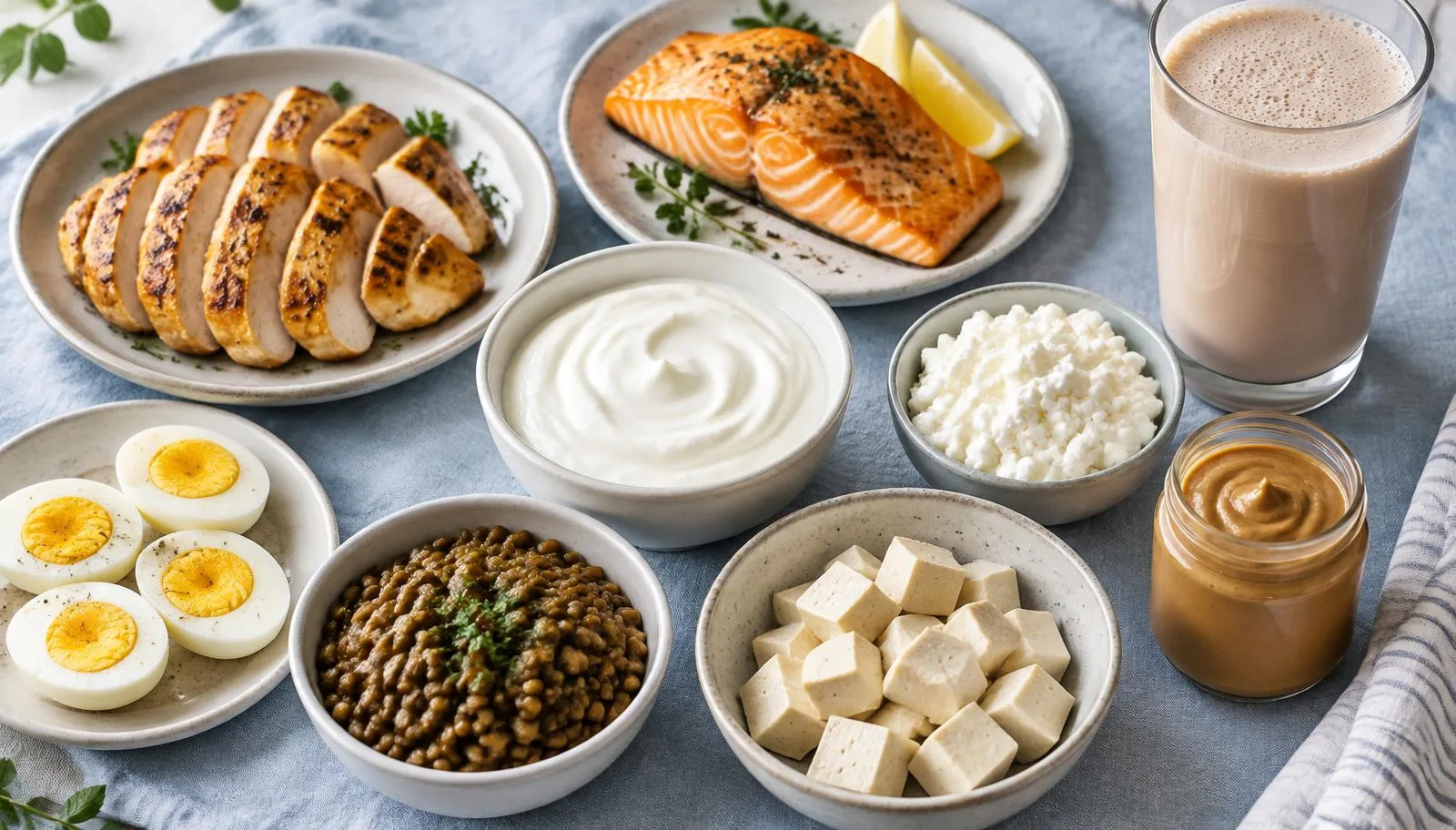
Choose protein foods that pack a lot into a small portion. The advisory recommends fish, eggs, Greek yogurt, cottage cheese, and nuts and seeds, plus beans, lentils, dairy and lean poultry. Here's roughly how much protein common foods give you, based on USDA data:
| Food | Serving | Protein |
|---|---|---|
| Chicken breast, roasted | 3 oz | About 26 g |
| Salmon, cooked | 3 oz | About 19 g |
| Plain nonfat Greek yogurt | 6 oz | About 16 g |
| Firm tofu | 3 oz | About 15 g |
| Cottage cheese, 2% | ½ cup | About 12 g |
| Lentils, cooked | ½ cup | About 9 g |
| Black beans, cooked | ½ cup | About 8 g |
| Peanut butter | 2 tbsp | About 7 g |
| Egg, hard-boiled | 1 large | About 6 g |
For overall health, the advisory suggests keeping red and processed meats, such as bacon and deli meats, to a minimum. See GLP-1 foods to avoid for more.
Feeling sick to your stomach? Read why GLP-1 nausea happens and when it fades and our guide on what to eat on semaglutide.
No, protein works best with exercise. The advisory is clear on this point:
“increased protein intake alone is likely inadequate to support the preservation of muscle mass in the absence of structured resistance/strength training”
Strength training means working your muscles against resistance: weights, resistance bands, or body-weight moves like squats and push-ups. Start small and build up. Our guide to exercise on a GLP-1 has simple ways to begin.
Yes. The same protein goals apply whether you take a brand-name or compounded GLP-1. Compounded semaglutide and tirzepatide are made by a licensed pharmacy for an individual patient with a prescription. Compounded medications are not FDA-approved, and they are not the same products as Ozempic, Wegovy, Zepbound or Mounjaro. The FDA explains this difference.
At Join Luma, compounded GLP-1 medications come from U.S. licensed 503A pharmacies, and every batch is tested by an outside lab. Test documents are available on request.
Same price every dose
A licensed provider reviews your intake. If treatment is appropriate, your medication ships free with expedited two-day delivery.
Get startedStart with a short online intake. A licensed doctor reviews it, usually within 24 hours, and decides whether semaglutide or tirzepatide is right for you. If you're prescribed, your medication ships free in 2 days with syringes and alcohol pads included. Support is available 24/7 if you have questions about eating, side effects or your plan.
Join Luma keeps the same price at every dose, with no membership fees. New GLP-1 patients can start compounded semaglutide at $99/mo for the first 3 months ($297 upfront), or compounded tirzepatide at $149/mo ($447 upfront). This discount helps people new to GLP-1 medication get started, then renews at affordable current-user pricing for the same plan length. Current GLP-1 users can choose a 6-month plan: semaglutide at $99/mo ($594 upfront) or tirzepatide at $149/mo ($894 upfront). You can also split upfront payments with Affirm, Klarna or Afterpay.
| Treatment | Starting at | 3-month total |
|---|---|---|
| Compounded semaglutide | $99/mo | $297 upfront |
| Compounded tirzepatide | $149/mo | $447 upfront |
| Compounded semaglutide ODT | $159/mo | $477 upfront |
| Compounded tirzepatide ODT | $179/mo | $537 upfront |
Current GLP users can access the same injection starting rates with a six-month plan: compounded semaglutide $99/mo ($594 upfront); compounded tirzepatide $149/mo ($894 upfront). Pay upfront or use Affirm, Klarna or Afterpay to split the payments, subject to eligibility and approval. Other billing options and oral current-user prices are listed on the pricing page. Treatment requires provider approval.
You can cancel upcoming orders anytime before your next billing date through the patient portal or by emailing support@joinluma.com. Learn more about weight loss injections at Join Luma, our oral weight loss option, or see all plan prices.
Join Luma (joinluma.com) is an independent online weight-loss care service and is not affiliated with any other company with a similar name.
Compounded medications are not FDA-approved and are not reviewed by the FDA for safety, effectiveness or quality before marketing. Brand-product study results describe the FDA-approved products studied. A licensed clinician decides whether treatment is appropriate; follow your prescription label and your clinician's directions.
This article is for educational purposes only and is not intended to provide medical advice, diagnosis, or treatment. Individual treatment decisions should be made with a licensed healthcare provider.
Many people do well aiming for about 80 to 120 grams of protein a day, a target suggested in a 2025 joint nutrition advisory. The basic adult minimum is 0.8 g per kilogram of body weight, and 1.2 to 1.6 g/kg has been proposed during active weight loss.
The same goals apply to semaglutide as to other GLP-1 medications: about 80 to 120 grams a day for most people, eaten across several small meals with protein first. Ask your doctor for a personal target.
Multiply your weight in pounds by 0.36 to get the basic minimum of 0.8 g/kg. For example, a 200-pound person needs at least about 73 grams a day. During weight loss, many people aim higher, within 80 to 120 grams.
If you eat 3 to 4 small meals, 80 to 120 grams a day works out to roughly 20 to 40 grams per meal. Eat the protein on your plate first.
Yes. Protein shakes can help when your appetite is low, and a 2025 nutrition advisory notes some people meet their protein goals with shakes, bars and fortified foods. Choose options low in added sugar.
Yes. The 2025 advisory says eating 2 g/kg of protein a day or more for a long time should be avoided. If you have kidney disease, talk with your doctor before increasing protein.
Not on its own. Protein works best with regular strength training, such as weights, resistance bands or body-weight exercises like squats and push-ups.
Share this article