Best Value
from$99/mo
SemaglutideRx
GLP-1 Receptor Agonist

SemaglutideRx
GLP-1 Receptor Agonist
TirzepatideRx
Dual GLP-1 + GIP Receptor Agonist
Semaglutide ODT PillsRx
GLP-1 Receptor Agonist - Oral Dissolving Tablet
Tirzepatide ODT PillsRx
Dual GLP-1 + GIP Receptor Agonist - Oral Dissolving Tablet
Men's Complete Hair Growth PillRx
Minoxidil, Finasteride, Biotin
Men's Advanced Hair SprayRx
Minoxidil, Finasteride, Fluocinolone, Tretinoin
Women's Premium Hair SprayRx
Minoxidil, Tretinoin, Fluocinolone, Biotin, Melatonin
Women's Complete Hair Growth PillRx
Minoxidil, Vitamin E, Biotin
Written by Join Luma Team
November 8, 2026 · 7 min read
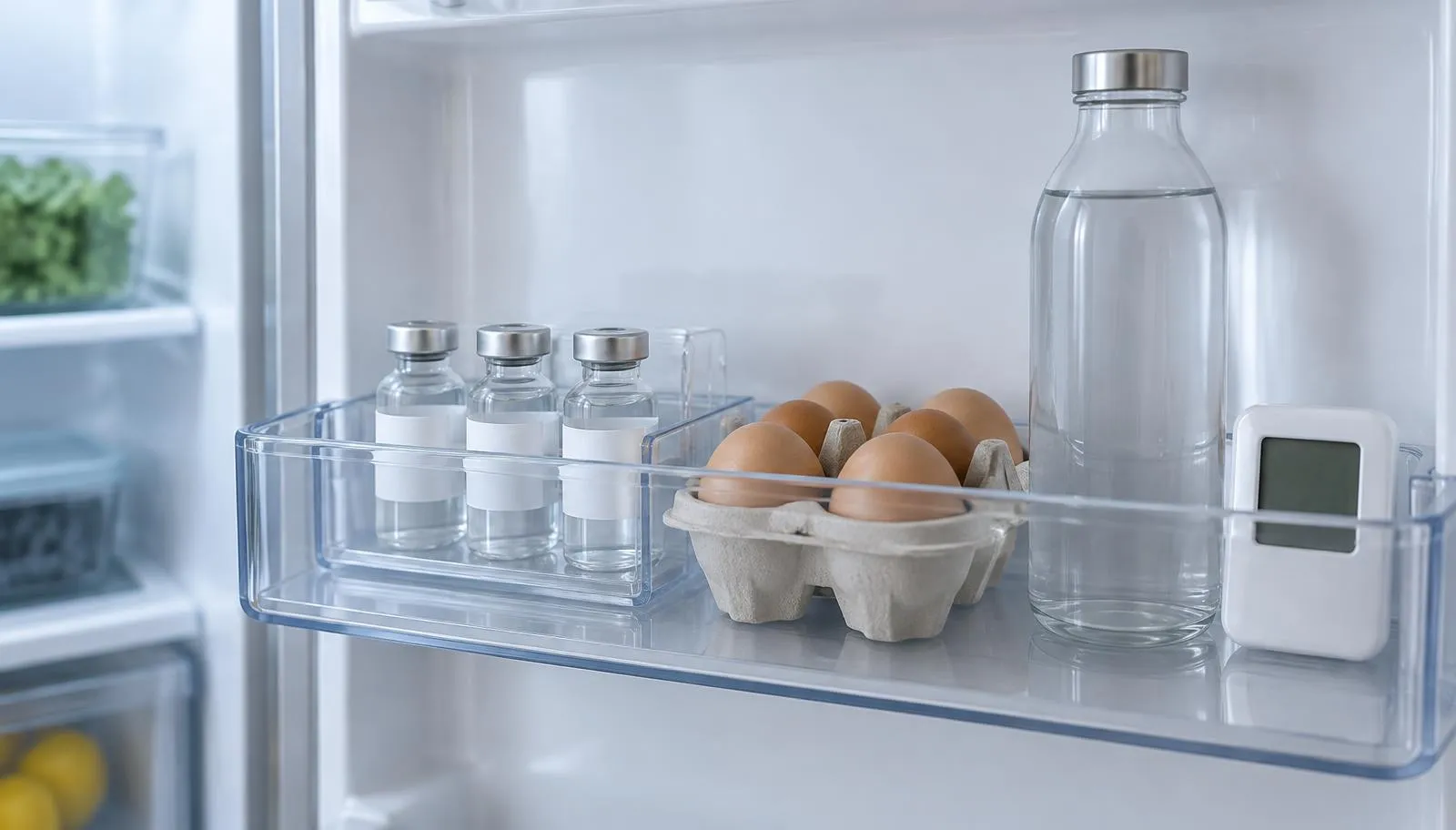
Compounded semaglutide lasts in the refrigerator only as long as the dispensing pharmacy’s label permits, including its beyond-use date and any earlier limit after first puncture.
Follow your prescription label and Join Luma clinician’s instructions. Unless your label says otherwise, refrigerate at 36–46°F (2–8°C), do not freeze, and protect the vial from light; there is no universal fridge lifespan for every compound.
A beyond-use date, often abbreviated BUD, is the date or time after which the compounded preparation should not be used. The dispensing pharmacy assigns it using applicable standards, including USP 797 for sterile preparations, and relevant preparation-specific information. It is not simply the date you received the shipment plus a standard number of weeks.
The pharmacy considers the preparation and its conditions rather than borrowing a branded pen’s shelf life. An unopened vial still has a BUD, and opening it can introduce an additional earlier use limit. Read the complete dispensing instructions, including any separate pharmacy handout, before assuming the last printed date is the only rule.
The USP sterile compounding overview explains why standards matter for preparations administered by injection. A clear-looking solution can still be unsuitable after its permitted use period. Appearance is not a substitute for dating, and refrigeration does not restart or extend the clock.
Unless the dispensing label directs otherwise, use a refrigerator maintained at 36–46°F (2–8°C). Store the vial away from a cooling element or a location where it might freeze. A stable shelf position in its protective packaging is generally more practical than a place exposed to frequent temperature swings.
Keep medication separate from food spills and out of reach of children. A refrigerator thermometer can help identify whether the storage area is actually within range. Do not place the vial in a freezer to compensate for a warm shipment, and do not assume a vial touching an ice pack is safe from freezing.
Protect the medication from light as directed. If the refrigerator loses power or the vial is accidentally left out, record the approximate time and conditions and ask the pharmacy or Join Luma what to do. There is no reliable universal allowance to apply to all compounded semaglutide products.
| Product presentation | Brand-label storage example | What not to assume |
|---|---|---|
| Wegovy single-dose injection pen | Refrigerate 36–46°F; label permits up to 28 days at 46–86°F before cap removal | That a compounded vial has the same room-temperature allowance |
| Ozempic multidose pen | In-use pen can be kept for 56 days under specified label conditions | That every punctured compounded vial lasts 56 days |
| Your compounded vial | Use the pharmacy BUD and any earlier puncture limit | That another product’s data extend your label |
The Wegovy prescribing information and Ozempic prescribing information describe their own products and presentations. Containers, formulations, preservatives, and supporting data differ. Even within a brand, presentations can have different instructions, so match the exact product rather than relying on a general internet summary.
“Do not freeze WEGOVY and do not use if it has been frozen.”
Follow the dispensing pharmacy’s instructions for your particular vial. Mark the first-puncture date if instructed and calculate the discard date using the specified interval. If the printed BUD arrives sooner than that interval would end, the earlier date still controls. A later shipment date does not change either deadline.
The CDC injection-safety guidance describes a general 28-day opened-multidose-vial principle unless another date is specified by the manufacturer. Do not use that general principle to invent a puncture period for a compounded preparation or override a shorter pharmacy instruction. Ask the dispensing pharmacist when the compound’s directions are unclear.
Use a new sterile needle and syringe for each injection, follow the supplied cleaning instructions, and never share your vial. Safe technique and correct storage address different risks; doing one well does not cancel the other. Do not combine leftover medication from separate vials to avoid a discard date.
Do not throw it away. Put the medication in the refrigerator and contact Join Luma. Keep the packaging and note when the package was delivered, when you opened it, and whether there is visible damage. These details help the care team and dispensing pharmacy assess the shipment.
The instruction to refrigerate a warm arrival is not a declaration that it is safe to inject. Do not use questionable medication while waiting for an assessment. A melted ice pack by itself does not reveal the complete temperature history, and feeling the vial by hand does not establish the maximum temperature it reached.
Join Luma provides free expedited two-day shipping once dispensed. Shipping service and usable-storage limits are separate issues. If you expect to be away, arrange a reliable delivery plan and contact support about any timing concern rather than leaving the package unattended and trying to reconstruct the exposure later.
Check the label before departure and ask the pharmacist about your planned travel duration. Use an insulated carrier that protects the vial from direct contact with frozen packs. Keep the original labeled packaging and supplies together, and avoid leaving medication in a parked car, checked luggage exposed to temperature extremes, or direct sunlight.
If flying, check current airline and security requirements for medication and syringes before travel. Refrigeration at a hotel can vary; some mini-fridges freeze items near the back, while others are designed mainly to cool drinks. Verify the temperature rather than assuming that every small refrigerator provides suitable storage.
Carry the pharmacy contact information and your current directions. The travel guide can help you plan questions for the clinician. Do not change your prescribed schedule or apply an FDA-approved pen’s room-temperature allowance to your compounded vial simply to fit a trip.
Contact Join Luma or the dispensing pharmacy if the vial may have frozen, the label is unreadable, the BUD has passed, the seal is damaged, or you see an unexpected change in the contents. Do not use medication with unexplained particles or appearance changes until the pharmacy advises you. A normal appearance is not proof of sterility or potency.
The pharmacy-identification guide helps you locate the right dispenser. Keep your concentration and dose instructions with the storage information so a replacement or refill does not lead to carrying over an outdated syringe marking.
Join Luma support is available 24/7 through the portal or support@joinluma.com; most inquiries receive a reply within one to two hours. For more routine questions, see the FAQ. Seek urgent care for severe abdominal pain, persistent vomiting with dehydration, or other severe symptoms rather than waiting for a storage discussion to resolve.
Same price every dose
A licensed provider reviews your intake. If treatment is appropriate, your medication ships free with expedited two-day delivery.
Get startedCompounded medications are not FDA-approved and are not reviewed by the FDA for safety, effectiveness or quality before marketing. Brand-product study results describe the FDA-approved products studied. A licensed clinician decides whether treatment is appropriate; follow your prescription label and your clinician's directions.
This article is for educational purposes only and is not intended to provide medical advice, diagnosis, or treatment. Individual treatment decisions should be made with a licensed healthcare provider.
No. Use your pharmacy’s beyond-use date and any earlier limit after first puncture. There is no universal 90-day rule for compounded semaglutide.
No. Ozempic’s in-use pen instructions apply to that branded product. Follow your compounded vial’s dispensing instructions instead.
No. Do not freeze your medication. Ask the dispensing pharmacy how to maintain the labeled conditions during travel.
Do not throw it away. Put it in the refrigerator and contact Join Luma for a shipment-specific assessment before using questionable medication.
No. Refrigeration does not extend the pharmacy’s beyond-use date or restart the permitted period after puncture.
Share this article